
For aviation business owners
AI is changing how students find and book a flight school.
Learn to put it to work in your own school, from an airline pilot who runs four aviation businesses on it. Small learning curve, no retainer, and you keep everything you build.
- Years in aviation
- 25+
- Aviation brands
- 4
- Founded
- 2010
The problem
Why do flight schools fall behind as AI moves faster?
AI moved faster than most schools' websites, booking and follow-up did. The tools are the easiest they have ever been, and the learning curve is small. The schools that put them to work correctly are growing. Most owners either ignore the tools or stack one friendly AI app on top of another and end up with code a developer would call slop.
The student who found you, then nothing happened
A student searches, finds your school, and then hits a page with no prices, a form nobody reads, or a voicemail that never gets returned. That student books with the school across the field. Nothing about it shows up in a report, so the owner never sees the money leave.
Tool on top of tool
Julian used to run his own sites on WordPress plugins. Each plugin was somebody else's code, it was never perfect, and he could not see inside it. The friendly AI builders repeat that pattern: an app built on another app, with slop code underneath. He fixed his own sites by getting closer to the code, and that is the part he teaches.
What JD Aero does instead
Julian shows the owner how search, the website, online booking, email follow-up and measurement work as one system, and how to run that system on AI tools you understand and own. You implement each priority with guidance and see the evidence yourself. Once you can do it for the website, you can do it for the rest of the school.

The guide
Who is behind JD Aero?
Julian Alarcon runs JD Aero Services. He is an airline pilot with more than 25 years in aviation and holds ATP, CFI, CFII and MEI certificates. Since 2010 he has built six aviation brands. He runs the four that are active today himself, from New York, code, content and booking systems included.
Why an airline pilot
He has taught primary students, instrument students and anxious travelers, so he knows what a student is worried about before the first call. Pages written by someone who has never answered those questions read like every other school's, and miss the one thing that would have closed the enrollment.
Cockpit and kitchen table
He runs the company from a cockpit and a kitchen table, with nobody answering phones. The websites, booking paths and follow-up emails he maintains every week, in English and Spanish, for pilots and for travelers, have to work while he is away. When one breaks or stops converting, he is the one who fixes it.
What you walk away knowing
You leave knowing why each page exists, which search it answers, how a call or a form becomes a booked lesson, and which numbers show whether the work is paying off. That understanding carries into the next thing you build.
Read Julian Alarcon's background, or open the four aviation businesses he runs and check them yourself.
The plan
How does working with JD Aero work?
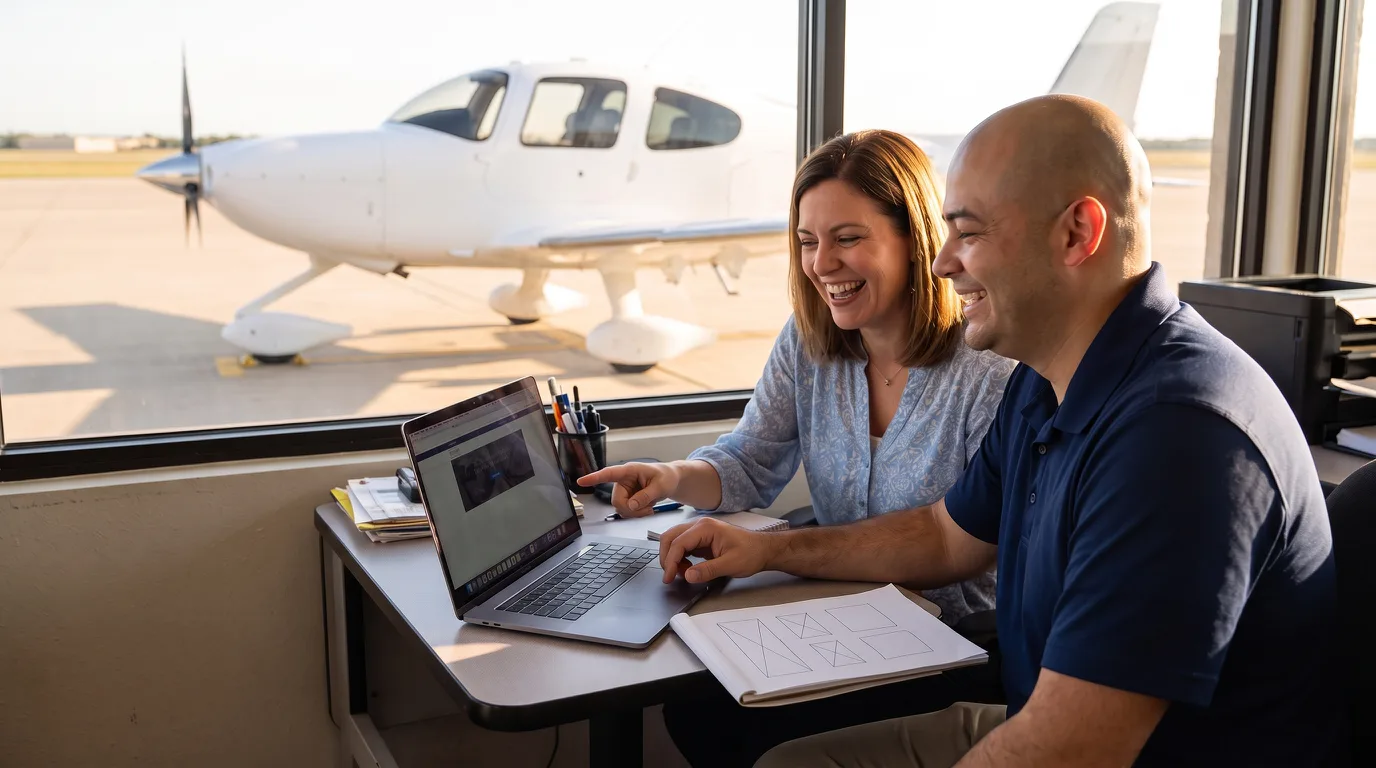
Three steps. First, write down the decision in front of you and the tools you already pay for. Second, book a paid working session where Julian turns that into an ordered plan on screen with you. Third, do the work yourself or with your team and measure what changed. There is no retainer and no long contract.
Step 1: name the decision
Bring the business goal, the student question behind it, and the tools you already pay for. A clear question gets a clear plan. "We need more students" becomes "we need to rank for one search and turn it into booked lessons".
Step 2: build the plan on screen
The session is live and shared. You watch the reasoning, ask questions while the decisions are made, and leave with an ordered list of what to do first and why, written for your school.
Step 3: implement and measure
You or your team do the work. Come back only when a new obstacle appears. What the numbers show decides the next move, and you will be reading them yourself.
AI, with a human in front of students
Can a flight school owner trust AI-built systems?
Not blindly. AI is a growing technique and it still makes mistakes. It earns trust when the owner is close enough to the code to see what it does, and learns from someone who runs real businesses on it. It also depends on keeping a human in front of students. Julian builds and connects his own systems this way, and teaches owners to do the same.
AI is the autopilot, not the pilot
An autopilot lowers workload, but a qualified pilot sets the objective, monitors the system and owns the result. AI in a small business works the same way. It speeds up research, drafting and implementation, and the owner supplies the facts, the judgment and the approval.
The questions an owner should be asking
Owners who get this right ask four questions:
- What tools are available to me? A website edited with an AI coding assistant, scheduler and payments joined by API, automated email
- How do I reduce the overhead? Booking and payment finish online; the payment record stays in the business, never the vendor's
- How do I show up on Google and in AI answers? Direct answers under each question heading, in plain HTML with structured data
- How do I build a tool for my own problem? One technique, carried into the rest of the school and measured in Search Console and analytics
A human stays in front of students
Students can tell when a school feels like a machine. The AI does the work behind the counter: drafting, wiring systems together, watching the numbers. The person who answers the phone, teaches the lesson and signs the email is still a named human, and the site should make that obvious.
The services page shows what that looks like for your website, search, booking and email.

One session at a time
What does a session cost?
Two one-time sessions, and the price on this page is the price the booking system charges. The Aviation Strategy Call is 30 minutes: one defined question or a quick review. The Aviation Consulting Session is 60 minutes: a deeper review with screen sharing and a custom roadmap. Neither one comes with a subscription or a retainer.
Which one to book
Book the strategy call when you can state the obstacle in one sentence. Book the consulting session when several pages or systems affect one another and you need the whole order of operations rather than a single answer.
What you keep
The recommendations, the recording where offered, and the implementation work are yours. There is no minimum number of sessions. You pay for the time you use.
How booking works
Pick a time on the calendar, pay at booking, and get a Zoom link and a reschedule link in the confirmation. The checkout runs the same verify-then-pay flow Julian teaches owners to build for their own students.
Aviation Strategy Call
Best for one clear question. Julian looks at what you have and tells you what to do first.
$49
30 minutes
Book the strategy callAviation Consulting Session
Best when several decisions hang together. You share your screen and leave with a roadmap written for your business.
$97
60 minutes
Book the consulting sessionBusinesses open today
Which aviation brands does JD Aero operate?
Four, all open today, each for a different kind of customer. Aviator.NYC runs simulator training with airline pilots in Hudson Square, Manhattan. Ready Roger coaches pilots remotely: ground school and home-simulator sessions over screen share. FlyCalm helps anxious travelers at calm.flights with airline pilots, and Vuelo Sin Miedo does that in Spanish.
Why the brands matter to an owner
They are the evidence. Their websites, booking paths, payment records and follow-up emails are the working experience behind every recommendation, and every one is live, so you can open it and check for yourself before you book a session with Julian.
One method, four markets
Each brand answers one clear customer problem, publishes for one defined search, and connects the answer to a next step. Together they show how one organic strategy carries across languages, locations and services while each brand keeps a focused promise.
See all the brands and what each one is for.

Aviator.NYC
Simulator training and airline-pilot instruction in Hudson Square, Manhattan. FAA-approved simulators.

Ready Roger
Remote ground school and simulator coaching with active airline pilots

FlyCalm
Fear-of-flying education with airline pilots

Vuelo Sin Miedo
Spanish-language fear-of-flying education with airline pilots
Bring the one thing that is not working.
Tell Julian which part of your website, booking or follow-up is failing, and leave with a plan you can run yourself.
Book a Strategy Session